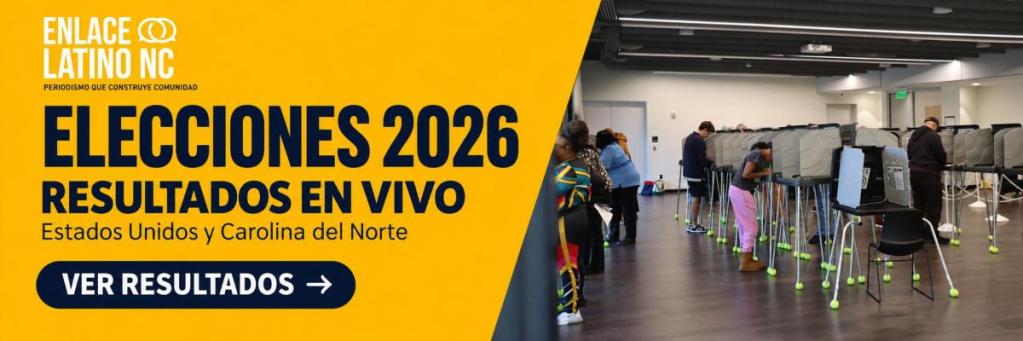
On November 3, North Carolina voters will not be electing a president or governor, but that doesn't mean there's little at stake.
The 2026 general elections will decide representatives in Washington and Raleigh, judicial positions and local authorities, as well as the renewal of the 170 seats in the General Assembly.
Voters will also have the final say on a proposal to amend the Constitution state.
The amendment requires a photo identification for mail-in voting, following approval by the state legislature.
Current state law requires identification for all forms of voting; this amendment would officially put it into the constitution.
The importance of the Latino vote
As of September 19, 364,737 people were registered as Hispanic on the North Carolina voter registration list, according to data from the State Board of Elections (NCSBE).
However, in the last midterm elections in 2022, only 25.8% of registered Hispanic voters cast a ballot, compared to a statewide turnout of just over 51%. according to the NCSBE.
In an election where several state, local, and federal races could be decided by narrow margins, Latino voter turnout could have a significant impact on the results.
What's at stake in the North Carolina General Assembly?
Voters will re-elect the 170 members of the North Carolina General Assembly50 senators and 120 representatives.
The General Assembly is the state legislative branch responsible for making the laws of North Carolina.
The decisions made by state legislators have a direct impact on the lives of residents.
Immigration, education, access to health care, elections, and the state budget are some of the issues that go through the General Assembly and can become laws that affect communities throughout the state.
Supreme Court and Court of Appeals: positions up for grabs in 2026
Also, in the 2026 election Charges from the North Carolina Supreme Court and the Court of Appeals appear.
The current electoral list includes a race for associate justice of the Supreme Court and three Court of Appeals positions.
In 2024, the state election for a Supreme Court seat ended with a difference of just 734 votes after a recount of more than 5.5 million votes.
After a 6-month legal battle, U.S. District Judge Richard Myers II ordered the North Carolina State Board of Elections to certify the victory of the Democratic judge. Allison Riggs.
Judge Myers II ruled, in May 2025, that the Republican candidate, the judge Jefferson GriffinHe couldn't "change the rules of the game once it was over."
The NCSBE also conducted a partial manual recount before concluding the process.
This year, the contest for another seat on the state's highest court is once again at the center of electoral attention, and a competitive race is anticipated.
Their vote also decides who represents North Carolina in Washington.”
In the general elections of November 3, 2026, The voters will choose who will represent North Carolina in their 14 congressional districts in the United States House of Representatives.
House members are elected for two-year terms, so the 14 state seats are up for grabs again this year.
Unlike the United States Senate —where the contest is statewide and all eligible voters in the state vote for the same candidates—, for the federal House each voter chooses only the representative of the congressional district where they reside.
The outcome of these 14 contests will determine who will represent the various regions of North Carolina in Washington for the next two years and will help define the composition of the United States House of Representatives.
A vote that could influence control of the federal Senate
North Carolina is emerging in the November elections as a national battleground for control of the U.S. Senate.
The seat was left open after the Republican senator Thom Tillis He announced in June 2025 that he would not seek a third term.
After the March primariesFormer Democratic Governor Roy Cooper and Republican Michael Whatley, former chairman of the Republican National Committee, emerged as the leading candidates to succeed him.
The race also highlights the weight that voter turnout can have in a state where federal contests have been competitive.
In 2020, Tillis won re-election by a margin of less than two percentage points.
You may be interested: What options do I have if they want to deny me the vote?
The local elections
The importance of voting in November doesn't end in Washington or Raleigh. Depending on where they live, voters will also be able to elect local officials who make decisions directly related to their communities.
School boards, mayors, city councils, and other local offices may appear on North Carolina voters' ballots in 2026.
Although these contests tend to receive less attention than elections to the federal Congress or Senate, they determine who will have a voice in decisions made directly in the community where the voters live.
Not all ballots are the sameThe local positions that appear depend on where each voter is registered.
One example is the city of Raleigh, the capital of North Carolina. In the November 2026 elections, city voters will elect the mayor and renew all the seats on the City Council.
The Council is made up of eight members: the mayor, two general representatives (at-large) elected by the entire city and five representatives from districts A, B, C, D and E.
The election will also mark a change in Raleigh's government. Starting in 2026, the city will transition to four-year terms and staggered elections.
The mayor, the representatives of districts A and B, and the candidate at-large The candidate who receives the most votes will be elected for four years; the representatives of districts C, D and E and the second candidate at-large They will be initially elected for two years.