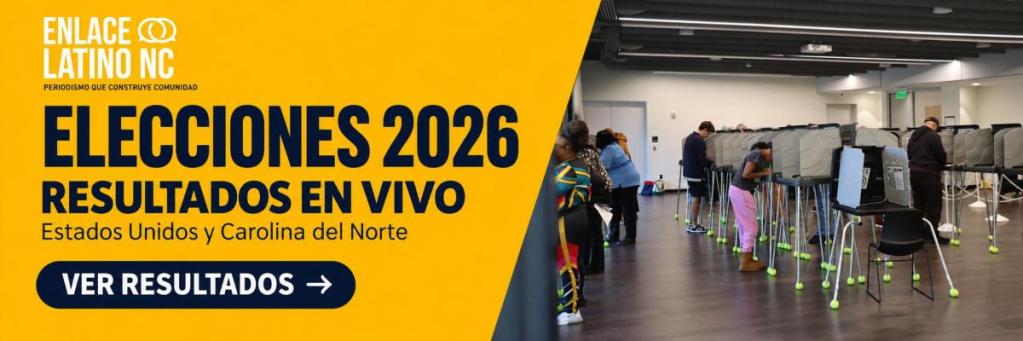
This new year, 2026, marks an important midterm election season that takes place every two years in North Carolina at the federal, state, and local levels, and that It will begin on March 3rd with the primary elections.
Enlace Latino NC spoke about the importance of the primary elections with Wendy Mateo, a political activist from the group. Latino Your Vote Counts, who for several years has been responsible for motivating Latino voters to go to the polls.
“In the primary elections, voters define who the candidates will be that will participate for each party in the general elections in November, that is why it is so important to participate, to select the candidate that we want the party to put forward, and that represents the interests and guidelines for which we are going to vote,” Mateo said.
This year there are several key competencies in primary education from North Carolina, where the parties' candidates will be defined for important federal positions such as the 4th District of the House of Representatives and one of the Senate seats.
Historically low participation
In the primary elections, voter participation has historically been lowAnd it is a phenomenon that occurs frequently not only among Latino voters, but in general terms.
“Most people don’t take these elections seriously, but if we don’t focus on the races with multiple candidates from different parties, and if we don’t choose a finalist to represent us, it will be too late for the general election in November,” Mateo emphasized. “That’s why we’re encouraging voters to participate,” he added.
In North Carolina, primary elections are partisan, meaning that the traditional Democratic and Republican parties will select, in races where there are several candidates, the one who will ultimately represent them in a given position.
“Candidates from the same party compete against each other, and the one who gets the most votes will go to the general elections in November,” he stressed.
According to statistical information from the State Board of Elections, in the primary elections held on March 5, 2024, 24.14% of voters statewide voted, and two years earlier, in 2022, the turnout was 19.80%.
Key races in North Carolina
This year, voters hold the power in their hands. choose in the primaries to the finalist candidates in several key competitions, at the federal, state and local levels.
Federal
Senate: One of North Carolina's two U.S. Senate seats is up for grabs in these primaries, in which Republican Senator Thom Tillis has decided not to seek another term. There are seven Republican candidates, eight Democrats, and four Libertarians running in the primary.
House of Representatives: The 14 districts are in primary elections, of which their 14 members, who are 10 Republicans and 4 Democrats, will seek re-election.
In these primaries, the Democratic Party will seek to gain more positions, with candidates who will seek to compete in the general elections in November.
There are Democratic primaries in the following districts: 3, 4, 6, 8, 9, 10, 11, 12, 13 and 14.
There are Republican primaries in the following districts: 1, 5, 7, 10, 11, 12, 13 and 14.
State legislature
All 120 House seats are up for election, as well as all 50 Senate seats.
There are several races to watch, including in District 106, which covers Mecklenburg County, currently represented by Democrat Carla Cunningham, who has held this seat for 10 years, and will face several fellow party members, including pastor and community advocate Rodney Sadler of Charlotte.
Cunningham has been criticized even by her fellow party members for making a series of comments described as "racist and inflammatory" and joining the Republican vote during a debate to override Governor Josh Stein's veto of HB 318.
Related: More than 50 North Carolina sheriffs will face primary elections in March 2026
Bailiffs
Alamance County will hold Republican primaries, with two candidates seeking to overtake Sheriff Terry Johnson, who has been in office for 23 years and became known for his anti-immigrant stance when he operated the 287g program in his jail and was investigated by the Department of Justice for making arrests based on racial profiling.
Democratic primaries will be held in Mecklenburg County where the current sheriff Garry McFadden He will face three fellow party members, including two former employees of his office.
McFadden gained attention from the immigrant community by promising to eradicate the 287g deportation program if he won the election, which he did in 2018 once he took command of the Sheriff's Office and the jails of Mecklenburg County.
“If we want to see changes like in District 106, or for Sheriff McFadden to remain in office, we need voters to turn out and vote in the primaries,” Mateo said.